Blood Tea; Darjeeling’s Finest
Interaction design that reveals a problem by making people feel it, not by telling them it exists.
A Darjeeling worker earns $3.74 a day. The same tea sells for up to $69 per 50g.
That $3.74 is conditional on plucking 25 kg of tea leaves in a day. The workers at the centre of this system are predominantly Nepalese-Indian women, who carry both economic exploitation and institutionalised racism, a compounding that makes their reality structurally harder to see at all.
I grew up in Darjeeling and have seen these conditions my whole life. Designing from Sydney, I grounded what I already knew in secondary research, so every figure on this page is defensible rather than anecdotal.
Daily wage figure: Tea Board of India. Retail price: 50g of First Flush Darjeeling, purchased from T2 in AUD and used in the exhibition.
My users didn’t know the problem existed, so the brief wasn’t to inform. It was to reveal.
Before designing anything, I ran light interviews with classmates, who are exactly the premium-tea consumers this system relies on. They were completely unaware the wage gap existed. That reframed the whole project. The challenge wasn’t persuading people who already cared; it was revealing a problem to an audience who didn’t know it was there. Awareness campaigns get scrolled past, and Fair Trade labels create confidence without guaranteeing that workers benefit.
I mapped the issue across three layers so it wouldn’t collapse into a single slogan: environmental (pesticide exposure harming workers’ health), social (wage disparity and colonial plantation structures), and consumer (the Fair Trade illusion). Holding all three kept the work from becoming either a political poster or a pretty object.
So I stopped trying to inform people, and built something they’d feel.
Blood Tea; Darjeeling’s Finest turns invisible labour into an interactive experience that moves the visitor from passive consumer to active participant. Three elements worked together as one system.
Digital labour simulation. Participants harvest tea on an iPad prototype and earn $3.74, the daily wage. The friction is deliberate: slowness, repetition, quota pressure. Products usually hide the labour inside them; this makes you feel it. The anticipation of drinking the tea keeps people engaged through the discomfort.
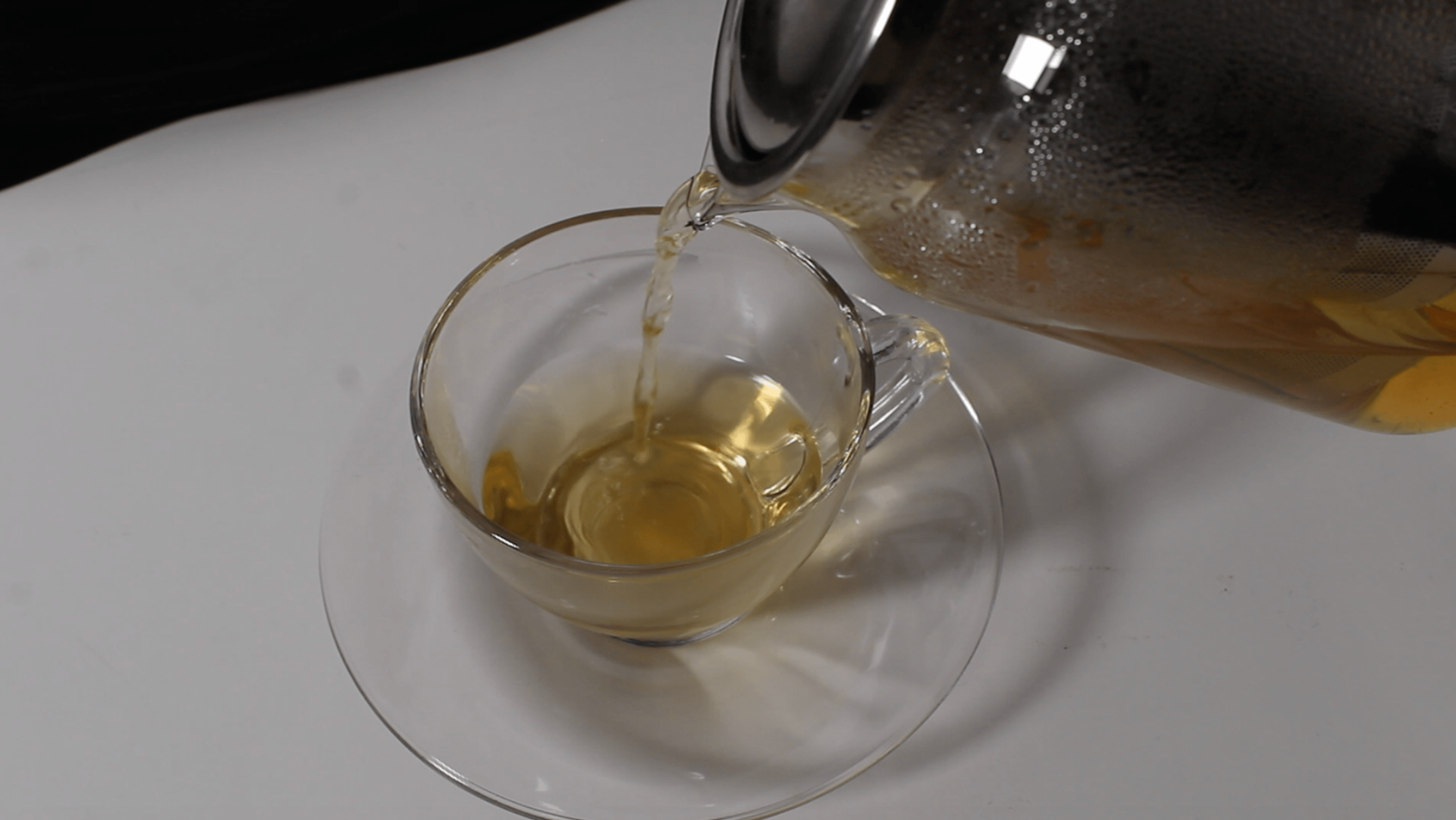
The proportional pour. The quantity of First Flush Darjeeling served is directly proportional to what was earned in the simulation. The moment a participant receives less tea than expected is the moment the disparity stops being a statistic and becomes something felt.
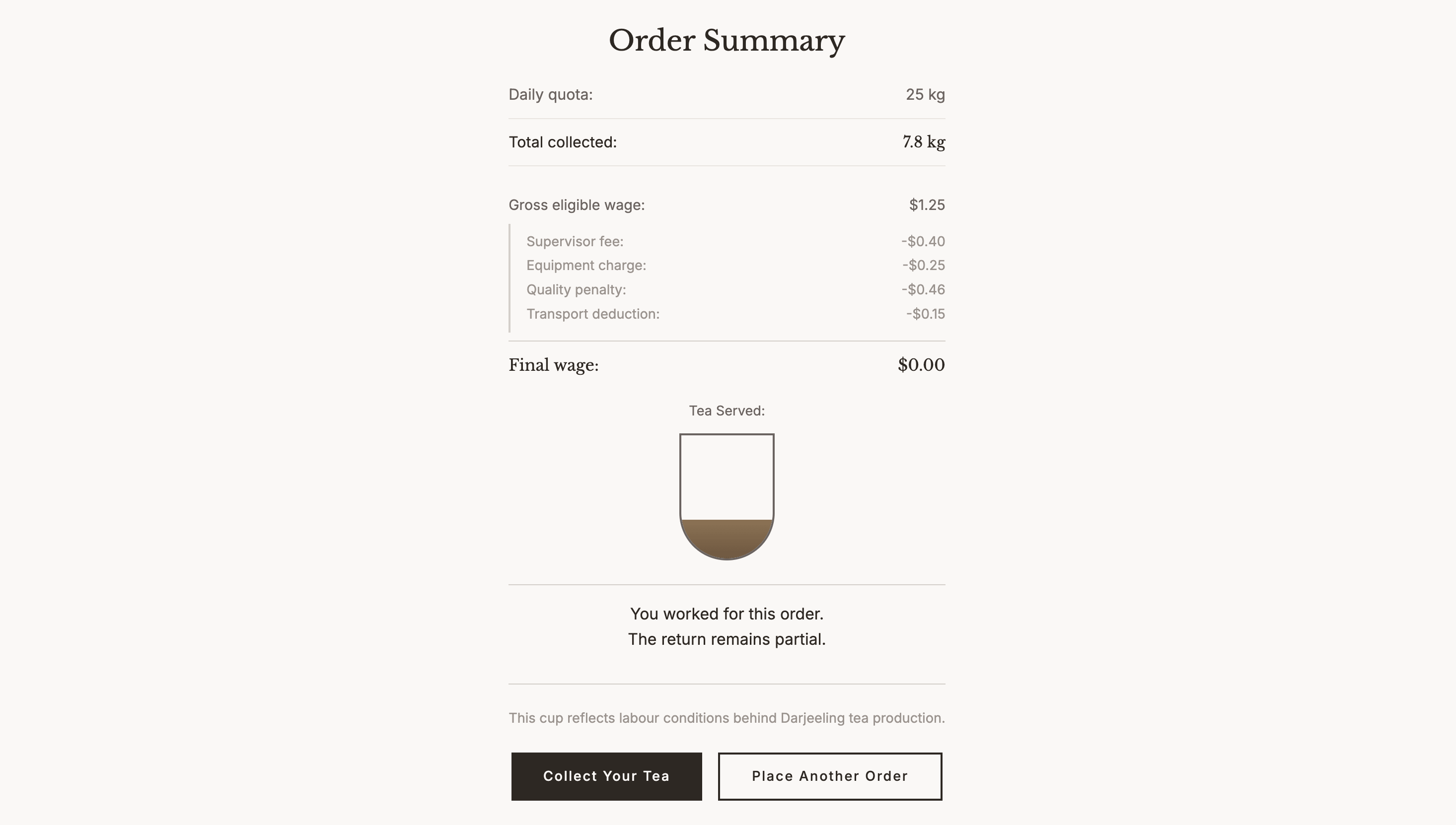
The adversarial receipt. A product hides the labour behind it; the receipt forces the two back together. Before drinking, each participant receives a receipt showing the retail price and the number of days a worker had to labour to afford that same cup. It is built to produce frustration, not sympathy, because sympathy is comfortable and doesn’t change behaviour.
All five senses are engaged, sight, sound, smell, touch, taste, which makes the experience hard to detach from.
→ View the digital prototypeEvery prototype removed something between the participant and the feeling.
I tested each version with three to four target-consumer participants. In the first weeks I ran A/B comparisons between approaches; after that it was rapid iteration, with the same structured questions after every session: did you learn anything about the tea, what did you think this was, and were you frustrated using it?
Prototype 1
Harvesting simulation with an earnings breakdown. People engaged with the plucking interaction, but the prototype ran too fast. The slowness and repetition were the empathy; losing them meant losing the point.
Prototype 1. Harvesting simulation with an earnings breakdown.
Kept: the harvesting interaction. Cut: the pace — the friction was gone.
Prototype 2
Five-day simulation with financial constraints. The instinct was right: anchor the experience in the wage itself. But requiring five simulated days of labour before the payoff was too long. Users gave up halfway, unsure what they were even working toward.
Prototype 2. Five-day simulation with financial constraints.
Kept: the wage as the anchor. Cut: the five-day duration — people dropped off before the point.
Prototype 3
Café framing with real-world plucking conditions. Introduced as a café experience: users placed an order, entered a simulation with real variables like rainfall and steep slopes slowing the harvest, and received a cup at the end. The framing and the sensory payoff worked. But the confrontation stayed vague. A tester’s feedback pinned it: translating “$69 for 50g of leaves” into a single cup just wasn’t connecting.
Prototype 3. Café framing with real-world plucking conditions.
Kept: the café framing. Cut: nothing yet — the confrontation still had no force.
Prototype 4 — Final
One day, one wage, one cup. Compressed to a single simulated day: you earn $3.74 for a cup, with real-world constraints embedded throughout. The adversarial receipt replaced the raw price comparison, showing both the retail cost and the equivalent days of labour behind that cup. Labour, time, reward and confrontation finally land as one continuous loop. I iterated the final interface through 66 versions in Figma Make before it worked.
Prototype 4 — Final. One day, one wage, one cup.
I chose structural inequality over personal narrative, deliberately.
A worker’s story would have made the project more personal, and I chose not to use one. Flattening lived experience into consumable content, as with the coverage around Rana Plaza, risks exploiting the very people the work means to represent. Making the system the subject, rather than a person, was an ethical position, not a limitation. It is also why I kept my own story out of the exhibition and put it into the research instead.
The discomfort was the mechanism. I calibrated the friction to produce empathy without losing participants, and the receipt moment was designed for frustration over sympathy, always, because frustration is what makes a comfortable consumer stop and look.
Selected from 111 projects for the Convenor’s Award.
Recognised for the clarity and depth of its design proposition at the Circular Resonance 2026 graduate exhibition.
“Connected research, interaction, taste, discomfort, and reflection in a compelling way.”
— Jury feedback, Circular Resonance 2026
People came for the tea, and left unsettled.
The real tea was the hook. Students came over to taste First Flush Darjeeling, and I watched more than ten of them work through the whole simulation on their own, when I wasn’t even at the table. Some asked for the tea they’d earned by finishing it. They arrived as consumers and left having felt the thing most awareness campaigns only state.
But the method carries. Designing an experience that reveals a problem by making someone feel it, rather than telling them it exists, is how I approach UX: start from what the user can’t yet see, and build the interaction that changes it.